Hydrogen–methane mixing
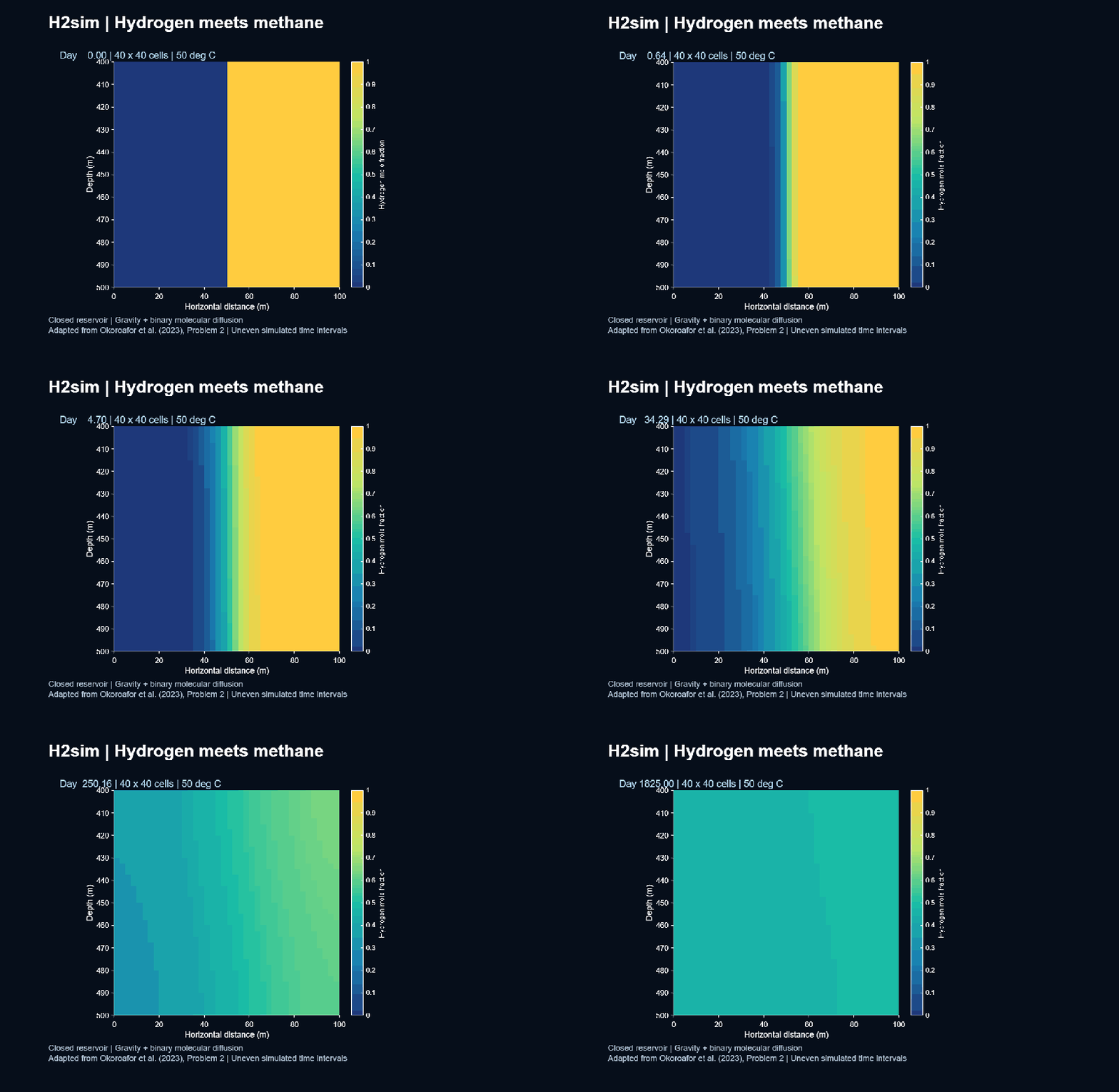
Watch hydrogen and methane redistribute in a small sealed reservoir section. This example adapts Problem 2 of Okoroafor et al. (2023), a published cross-simulator hydrogen-storage benchmark. Hydrogen initially occupies the right half; methane occupies the left. Gravity and molecular diffusion act without injection, withdrawal, water, microbial reactions or PHREEQC.
Colors show hydrogen mole fraction, with a fixed scale from zero to one. Depth increases downward. Frames are actual initial and accepted simulation states. The simulated time intervals are unequal and labelled on every frame; playback speed is not proportional to physical time. This is a mixing example, not an injection–withdrawal cycle or a prediction for a real storage site.
Download the MP4 or
GIF.
The provenance record
records parameters, component inventories and source/asset checksums.
Run and redraw
This example was added after v0.1.0. Use a development checkout containing
exampleHydrogenMixing2D; the original v0.1.0 tag does not include it.
From the repository root in MATLAB:
startupH2sim
result = exampleHydrogenMixing2D();
files = animateHydrogenMixing2D(result, fullfile('build', 'mixing'));
The solver creates no plots or output files. The renderer writes MP4, GIF and a PNG poster separately, so saved results can be rendered again:
save('mixingResults.mat', 'result', '-v7');
load('mixingResults.mat', 'result');
animateHydrogenMixing2D(result, fullfile('build', 'mixing'));
For a smaller setup check, use 'gridSize', [8, 8], 'durationDays', 30
and 'outputCount', 12. This does not reproduce the displayed 40-by-40 run.
MP4 writing requires MATLAB’s MPEG-4 VideoWriter profile. On platforms without
that profile, pass 'writeVideo', false to export the GIF and poster.
Model and provenance
Parameter |
Value |
|---|---|
Section / depth |
100 m wide, 100 m high; depth 400–500 m; 1 m extrusion |
Grid |
40 by 40 cells |
Porosity / permeability |
0.1 / 1e-14 m² |
Temperature / top reference pressure |
323.15 K / 4 MPa |
Binary molecular diffusivity / tortuosity |
7.26e-5 m²/s / 1 |
Duration / saved steps |
1825 days / 80 logarithmically spaced steps |
Thermodynamics |
Peng–Robinson, MRST tabulated H₂/CH₄ properties; zero binary interaction |
Transport |
H2sim mass-fraction Fickian diffusion and TPFA Darcy flux |
Component convergence uses a 1e-8 normalized mass-residual tolerance.
The displayed run completed all 80 steps; maximum relative component mass
errors were 4.28e-10 (H₂) and 6.45e-10 (CH₄) on Windows MATLAB
R2026a Update 5. This is a local run record, not a cross-platform guarantee.
Each starting gas column is initialized to an approximate hydrostatic profile with a shared top reference pressure. Pure end members use the EOS numerical composition floor. The example-specific diffusivity state function supplies the published constant coefficient; it does not change the default H2sim diffusion correlation used by other models.
This is an independently implemented coarse-grid adaptation, not a claim of exact reproduction of the paper’s EOS choices, viscosity treatment, mesh or reference profiles. The public benchmark repository contains comparison data; those data are not bundled or plotted as H2sim output here. An external profile comparison is still needed before describing this example as benchmark-validated.
Source: Okoroafor et al., Intercomparison of numerical simulation models for hydrogen storage in porous media using different codes (2023). Public data: Stanford/SUETRI-A Underground Hydrogen Storage (MIT license). New H2sim implementation files retain the project’s GPL-3.0-or-later notice.
Checks and limits
The example checks finite positive pressures, bounded normalized component
fractions and saturations, and conservation of both component masses to
1e-5 relative over the closed simulation. Diagnostics retain component
masses in kilograms and the mass-weighted hydrogen depth.
HydrogenMixing2DTest checks the geometry and sealed controls, a stationary
zero-diffusion/zero-gravity limit, mixing with diffusion alone, upward hydrogen
movement with gravity, independent gas-EOS inventory accounting, invalid inputs,
and GIF/poster export. These checks establish behavior and conservation for
small cases; they do not establish grid convergence or agreement with external
simulators. See Local verification for the broader dated verification record.