
Processes and validation
Mocca's library holds processes from published studies, set up at the papers' operating conditions. Read one by name with read_process, change a setting and run it:
using Mocca
library_processes()
process = read_process("krishnamurthy_2014_lpp_vsa")
This page compares Mocca's results for each of them with the paper's, and says where they differ and why, as far as it is known.
How Mocca compares
Mocca's results against the published ones. A point on the diagonal is an exact match; the dotted lines are ±10%. 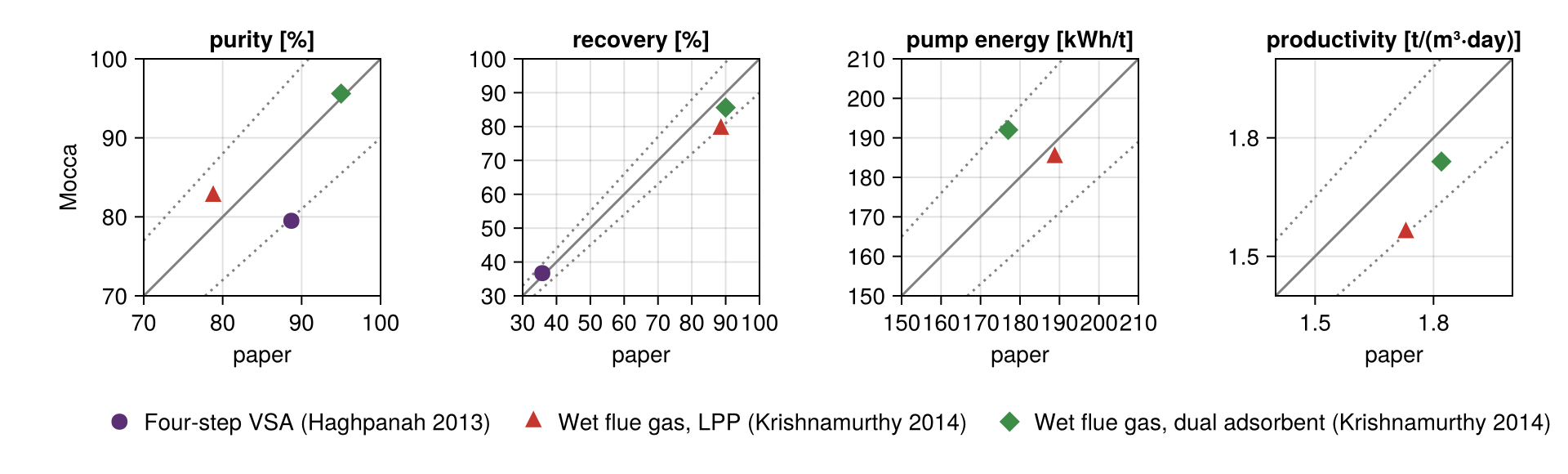
| Process | Purity | Recovery | Pump energy | Productivity | |
|---|---|---|---|---|---|
| Four-step VSA | paper | 88.7% | 35.8% | ||
| Mocca | 79.5% | 36.7% | |||
| Wet flue gas, LPP | paper | 78.8% (95.2% dry) | 88.6% | 188.8 kWh/t | 1.73 t/(m³·day) |
| Mocca | 82.6% (97.5% dry) | 79.2% | 185 kWh/t | 1.56 t/(m³·day) | |
| Wet flue gas, dual adsorbent | paper | 95% | 90% | 177 kWh/t | 1.82 t/(m³·day) |
| Mocca | 95.6% | 85.6% | 192 kWh/t | 1.74 t/(m³·day) |
The energy counts the vacuum pumps only, as the papers do; performance also counts the feed compressor. Productivity is per m³ of 13X. Purities with water count the water in the CO₂ product.
What is known about the differences:
Four-step VSA. Mocca's purity is about 9 points below the paper's at the same recovery, and the difference does not change with the grid, the time step or the heat model. Its cause has not been found yet.
Wet flue gas, LPP. Water builds up in the bed over hundreds of cycles, and after the 300 cycles of the example the CO₂ balance is still 0.7% open. Mocca pressurises with nitrogen where the paper uses stored light product. Recovery is 9 points below the paper's.
Wet flue gas, dual adsorbent. The CO₂ balance closes after 131 cycles, but the silica gel is still filling with water, and in Mocca a few hundred ppm of water reach the 13X bed, against 20 ppm in the paper. Recovery is 4 points lower and the energy 8% higher.
Four-step VSA
Haghpanah et al. (2013): dry flue gas, one bed of zeolite 13X. Library name "haghpanah_2013_four_stage_vsa".
| Setting | Value |
|---|---|
| Feed | 15% CO₂ in N₂, 25 °C, 1 bar, interstitial velocity 1 m/s |
| Column | 1 m long, 0.289 m inner diameter, with the steel wall |
| Pressures | 1 bar adsorption, 0.2 bar blowdown, 0.1 bar evacuation |
| Steps | pressurisation 15 s, adsorption 15 s, blowdown 30 s, evacuation 40 s |
The Getting started example runs it, and How a VSA cycle works follows it through one cycle.
Two-bed VSA
Built in Mocca from the beds of Haghpanah et al. (2013), to show a multi-bed cycle; it has no published counterpart. Make it with two_bed_vsa_process().
Evacuating to 0.1 bar, it gives 57.4% purity, 60.6% recovery and 93.4 kWh/t, pumps and compressor together. The Two-bed VSA with pressure equalisation example builds it step by step and shows what the equalisation is worth.
Wet flue gas, light product pressurisation
Section 3 of Krishnamurthy et al. (2014): wet flue gas, one bed of zeolite 13X. Library name "krishnamurthy_2014_lpp_vsa".
| Setting | Value |
|---|---|
| Feed | 15% CO₂, 82% N₂, 3% H₂O, 25 °C, 1.013 bar, interstitial velocity 0.45 m/s |
| Column | 1 m long, 0.3 m inner diameter |
| Pressures | 1.013 bar adsorption, 0.08 bar blowdown, 0.03 bar evacuation |
| Steps | LPP 20 s, adsorption 78.4 s, blowdown 37.9 s, evacuation 111.6 s |
The Wet flue gas: single-bed VSA with light product pressurisation example runs it and compares its bed profiles with the paper's.
Wet flue gas, dual adsorbent
Section 4 of Krishnamurthy et al. (2014): a silica gel bed takes the water out of the wet flue gas before a 13X bed captures the CO₂. Library name "krishnamurthy_2014_dual_adsorbent_vsa".
| Setting | Value |
|---|---|
| Feed | 15% CO₂, 82% N₂, 3% H₂O, 25 °C, 1.013 bar, interstitial velocity 0.7 m/s |
| Columns | silica gel 0.41 m long, 13X 1 m long, both 0.3 m inner diameter |
| Pressures | silica gel down to 0.48 bar and then 0.3 bar through its bottom; 13X down to 0.07 bar through its top and then 0.03 bar through its bottom |
| Steps | silica gel 154 s and then closed until the 13X bed finishes its 224 s |
The Wet flue gas: dual-adsorbent, two-bed VSA example runs it and follows the water into the 13X bed.