
Two-bed VSA with pressure equalisation
This example builds a process of two beds that work in turn: while one bed is pressurised and fed, the other is evacuated. Between the two halves of the cycle, a pressure equalisation joins the tops of the beds, so that the bed that has just been fed passes some of its gas to the bed that has just been evacuated, instead of sending it to the vacuum pump.
feed ──V_feed_A──┐               ┌──V_product_A── raffinate
                 bottom  A  top ─┤
CO2 ◄─V_vacuum_A─┘               │
                                V_eq
feed ──V_feed_B──┐               │
                 bottom  B  top ─┤
CO2 ◄─V_vacuum_B─┘               └──V_product_B── raffinate
The cycle has six stages:
| Stage | Bed A | Bed B |
|---|---|---|
| 1 | pressurisation | evacuation |
| 2 | adsorption | evacuation |
| 3 | equalisation, A to B | equalisation, A to B |
| 4 | evacuation | pressurisation |
| 5 | evacuation | adsorption |
| 6 | equalisation, B to A | equalisation, B to A |
The beds and gas are those of Haghpanah et al. (2013), as in Getting started. The same process is ready-made as Mocca.two_bed_vsa_process().
import Mocca
using Mocca.Units
1. The flowsheet
Two beds, each with a feed, a product and an extract device, and a link between their tops. A link is a valve with a bed at each end; the equalisation steps find it by the beds it joins.
gas = Mocca.haghpanah_2013_gas()
feed = Mocca.Feed(gas; composition = (CO2 = 0.15, N2 = 0.85), temperature = 298.15, pressure = 1bar)
adsorbent = Mocca.load_adsorbent("zeolite_13x_haghpanah_2013")
column = Mocca.haghpanah_2013_column()

fs = Mocca.Flowsheet(gas, feed)
for b in (:A, :B)
    Mocca.add_bed!(fs, b, adsorbent, column; ncells = 20)
    Mocca.add_device!(fs, Symbol(:V_feed_, b), :feed; at = (b, :bottom))
    Mocca.add_device!(fs, Symbol(:V_product_, b), :product; at = (b, :top))
    Mocca.add_device!(fs, Symbol(:V_vacuum_, b), :extract; at = (b, :bottom))
end
Mocca.add_device!(fs, :V_eq, :link; from = (:A, :top), to = (:B, :top))
fs
Flowsheet with 2 units and 7 devices for CO2, N2
A: fixed bed of zeolite 13X, 20 cells
bottom V_feed_A (feed), from boundary at 1.0 bar; V_vacuum_A (extract), to boundary at 1.0 bar
top V_product_A (product), to boundary at 1.0 bar; V_eq (link) to B top
B: fixed bed of zeolite 13X, 20 cells
bottom V_feed_B (feed), from boundary at 1.0 bar; V_vacuum_B (extract), to boundary at 1.0 bar
top V_product_B (product), to boundary at 1.0 bar; V_eq (link) to A top2. The cycle
With several beds, each step names its bed, and Concurrent runs steps on different beds at the same time, as one stage. Equalise opens the link between two beds, and gas flows from the one at the higher pressure. The size of the link valve, its conductance [mol/(s·Pa)], sets how far the pressures come together in the time given.
Pressures carry over from step to step within each bed. After an equalisation both beds are taken to be at the mean of their pressures, which is where the next pressurisation and evacuation ramps start. The evacuation of each bed runs through two stages, the second carrying on along the ramp of the first.
t_press, t_ads, t_eq = 15.0, 15.0, 10.0
P_eq = 0.55bar
evacuate(b, t, from) = Mocca.Evacuate(t; bed = b, from = from, to = 0.1bar)
P_mid = 0.1bar + (P_eq - 0.1bar) * exp(-0.5 * t_press)   # the ramp at 0.5 s⁻¹ after the first stage
cycle = Mocca.Cycle([
    Mocca.Concurrent(Mocca.Pressurise(t_press; bed = :A, from = P_eq), evacuate(:B, t_press, P_eq)),
    Mocca.Concurrent(Mocca.Adsorb(t_ads; bed = :A, velocity = 1.0), evacuate(:B, t_ads, P_mid)),
    Mocca.Equalise(t_eq; beds = (:A, :B), conductance = 1e-6),
    Mocca.Concurrent(Mocca.Pressurise(t_press; bed = :B, from = P_eq), evacuate(:A, t_press, P_eq)),
    Mocca.Concurrent(Mocca.Adsorb(t_ads; bed = :B, velocity = 1.0), evacuate(:A, t_ads, P_mid)),
    Mocca.Equalise(t_eq; beds = (:B, :A), conductance = 1e-6),
])
Cycle of 10 steps
pressurisation 15.0 s A
evacuation 15.0 s B
adsorption 15.0 s A
evacuation 15.0 s B
equalisation A to B 10.0 s A, B
pressurisation 15.0 s B
evacuation 15.0 s A
adsorption 15.0 s B
evacuation 15.0 s A
equalisation B to A 10.0 s B, AThe process lists each stage and the devices it opens:
process = Mocca.Process(fs, cycle; name = "two-bed VSA")Process two-bed VSA: CO2/N2 feed at 1.0 bar, 298.15 K, capturing CO2
A: fixed bed of zeolite 13X, 20 cells
bottom V_feed_A (feed), from boundary at 1.0 bar; V_vacuum_A (extract), to boundary at 0.1 bar
top V_product_A (product), to boundary at 1.0 bar; V_eq (link) to B top
B: fixed bed of zeolite 13X, 20 cells
bottom V_feed_B (feed), from boundary at 1.0 bar; V_vacuum_B (extract), to boundary at 0.1 bar
top V_product_B (product), to boundary at 1.0 bar; V_eq (link) to A top
cycle of 6 stages, 80.0 s:
A pressurisation, B evacuation 15.0 s V_feed_A, V_vacuum_B
A adsorption, B evacuation 15.0 s V_feed_A, V_product_A, V_vacuum_B
equalisation A to B 10.0 s V_eq
B pressurisation, A evacuation 15.0 s V_vacuum_A, V_feed_B
B adsorption, A evacuation 15.0 s V_vacuum_A, V_feed_B, V_product_B
equalisation B to A 10.0 s V_eq3. Cyclic steady state and performance
Two beds approach their steady state more slowly than one when the cycle is simply repeated, but after three plain cycles Newton's method needs only about ten iterations.
result = Mocca.cyclic_steady_state(process)
perf = Mocca.performance(result)
println("converged: $(result.converged) after $(result.iterations) cycles")
println("purity $(round(100perf.purity, digits = 1))%, recovery $(round(100perf.recovery, digits = 1))%, ",
    "$(round(perf.specific_energy, digits = 1)) kWh/t")
converged: true after 14 cycles
purity 57.4%, recovery 60.6%, 93.4 kWh/tThe streams through the devices over the cycle. The link carries gas from A to B in the first equalisation (positive flow, from its inlet at A) and back in the second:
f_streams = Mocca.plot_flowsheet_streams(result.states, process.model, result.timesteps;
    stages = Mocca.stages(process), devices = [:V_feed_A, :V_vacuum_A, :V_product_A, :V_eq])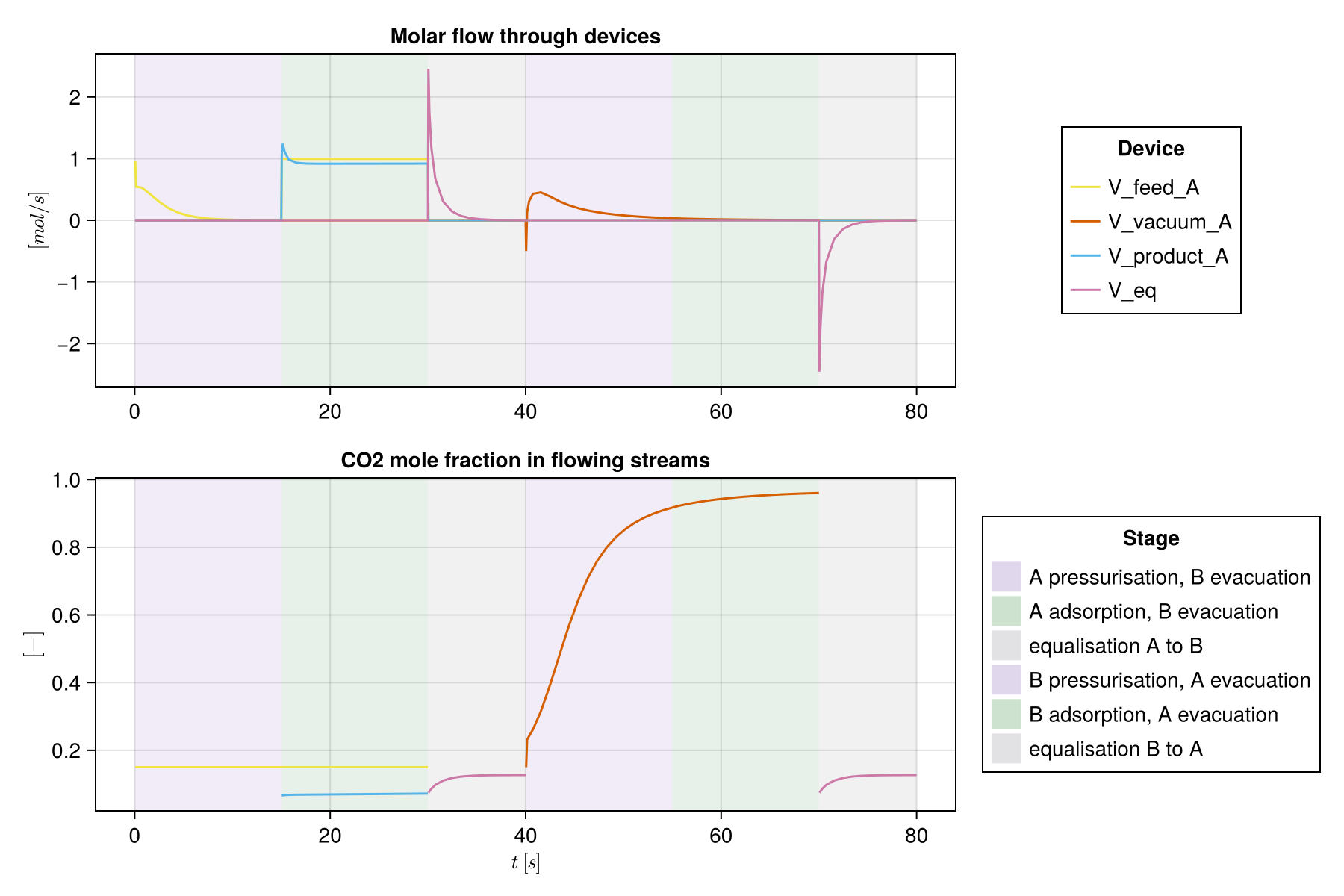
The top of each bed through the cycle. The beds run half a cycle apart, and their pressures meet at about half a bar in each equalisation:
f_beds = Mocca.plot_cell_comparison(["A" => ([s[:A] for s in result.states], result.timesteps),
    "B" => ([s[:B] for s in result.states], result.timesteps)], fs[:A], 20)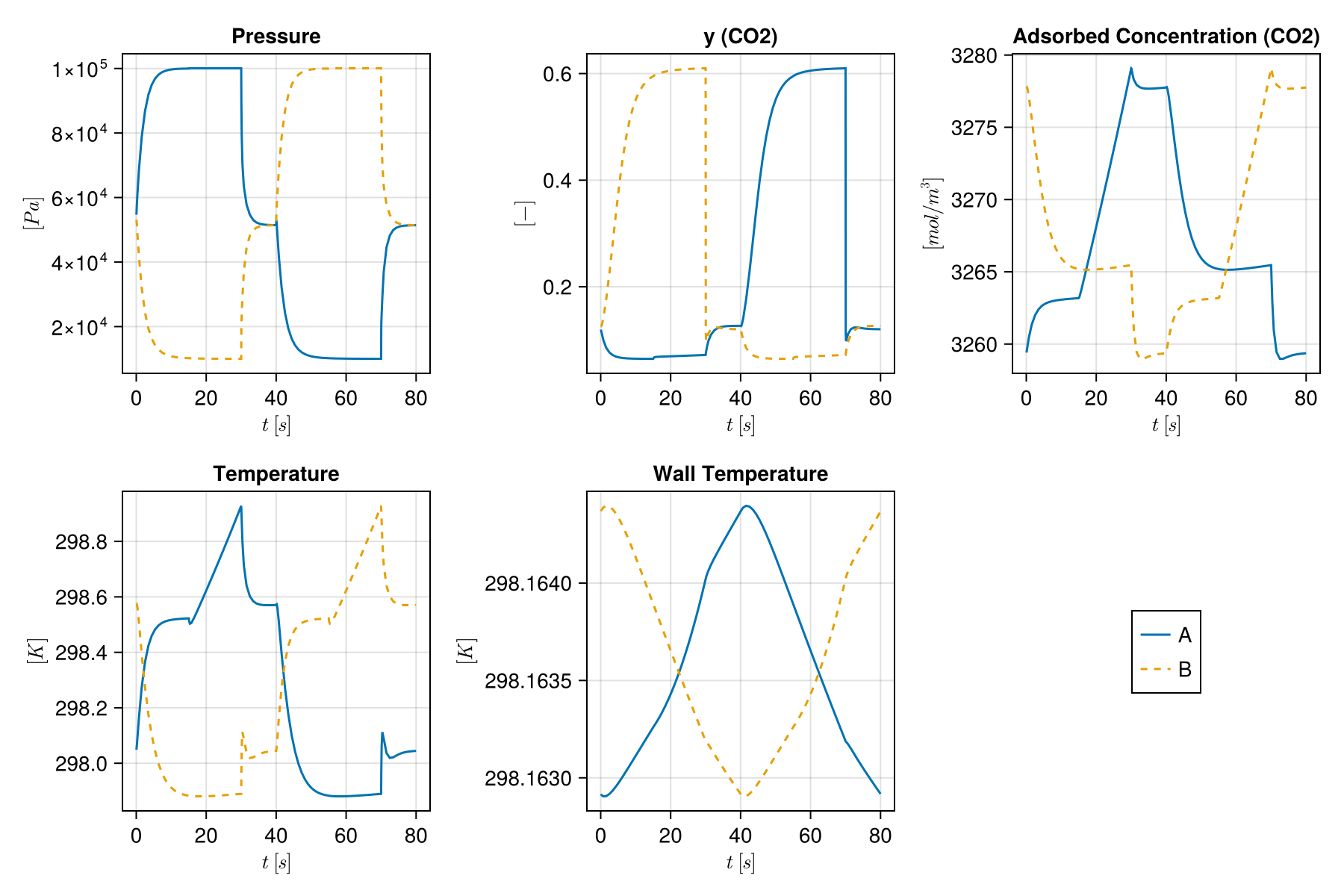
4. The stream table of each stage
write_results writes the stream table of each stage to stage_streams.csv. It shows how much gas moves between the beds during equalisation, and what it is:
dir = joinpath(mktempdir(), "two_bed")
Mocca.write_results(dir, result)
lines = readlines(joinpath(dir, "stage_streams.csv"))
header = split(lines[1], ',')
columns = indexin(["Stage", "Device", "From", "To", "CO2 [mol%]", "Total [mol/stage]"], header)
for line in filter(contains("equalisation"), lines)
    println(join(split(line, ',')[columns], ", "))
end
equalisation A to B, V_eq, A top, B top, 9.7833015, 1.309432
equalisation B to A, V_eq, A top, B top, 9.7833015, -1.309432About 1.3 mol of gas, with 10% CO₂, moves from A to B in the first equalisation, and the same back in the second (a negative amount: against the direction of the link).
Stage names with a comma, such as "A adsorption, B evacuation", are quoted in the file, so only the equalisation rows are split this simply here. A spreadsheet or a CSV reader such as CSV.jl reads them all.
The mass balance over the cycle in summary.csv closes over both beds:
foreach(println, filter(startswith("Mass balance"), readlines(joinpath(dir, "summary.csv"))))Mass balance,CO2 in,4.9519554,mol/cycle
Mass balance,CO2 out,4.9519554,mol/cycle
Mass balance,CO2 accumulated in beds,-4.9283244e-10,mol/cycle
Mass balance,CO2 imbalance,1.3035499e-8,% of in
Mass balance,N2 in,28.06108,mol/cycle
Mass balance,N2 out,28.06108,mol/cycle
Mass balance,N2 accumulated in beds,6.8973272e-11,mol/cycle
Mass balance,N2 imbalance,-2.3004803e-9,% of in
Mass balance,Total in,33.013036,mol/cycle
Mass balance,Total out,33.013036,mol/cycle
Mass balance,Total accumulated in beds,-4.2385917e-10,mol/cycle
Mass balance,Total imbalance,-8.8782771e-14,% of in5. What the equalisation is worth
A design variable that sets the conductance of the link in both equalisation steps. Nearly closing it leaves the gas of the fed bed to the vacuum pump. The steady state for the new setting starts from the one already found.
Mocca.add_variable!(process, :C_eq, ("equalisation A to B", :conductance), ("equalisation B to A", :conductance))
process[:C_eq] = 1e-9
result_no_eq = Mocca.cyclic_steady_state(process)
println("converged: $(result_no_eq.converged) after $(result_no_eq.iterations) cycles")
no_eq = Mocca.performance(result_no_eq)
for (label, p) in ("with equalisation" => perf, "without" => no_eq)
    println(rpad(label, 20), "purity $(round(100p.purity, digits = 1))%, recovery $(round(100p.recovery, digits = 1))%, ",
        "$(round(p.specific_energy, digits = 1)) kWh/t")
end
converged: true after 9 cycles
with equalisation purity 57.4%, recovery 60.6%, 93.4 kWh/t
without purity 41.3%, recovery 59.2%, 101.3 kWh/tEqualisation sends the nitrogen-rich gas left in the fed bed to the other bed, rather than into the CO₂ product through the vacuum line, which raises the purity by about 16 percentage points and saves pump work.
Example on GitHub
If you would like to run this example yourself, it can be downloaded from the Mocca.jl GitHub repository.
This page was generated using Literate.jl.