
Adsorbents
Mocca's library holds the adsorbents of published studies. Load one by name with load_adsorbent, and list them with library_adsorbents():
using Mocca
library_adsorbents()
adsorbent = load_adsorbent("zeolite_13x_haghpanah_2013")
Each has a dual-site Langmuir isotherm (see Model equations) and the particle properties that set the mass transfer rate. The figures show the pure-component isotherms in mol/kg at three temperatures, computed with isotherm_table; the tables give the parameters as they are in the file, with capacities in mol per m³ of adsorbent particles.
Zeolite 13X (Haghpanah et al. 2013)
The adsorbent of the four-step and two-bed VSA processes, for dry flue gas. Library name "zeolite_13x_haghpanah_2013". 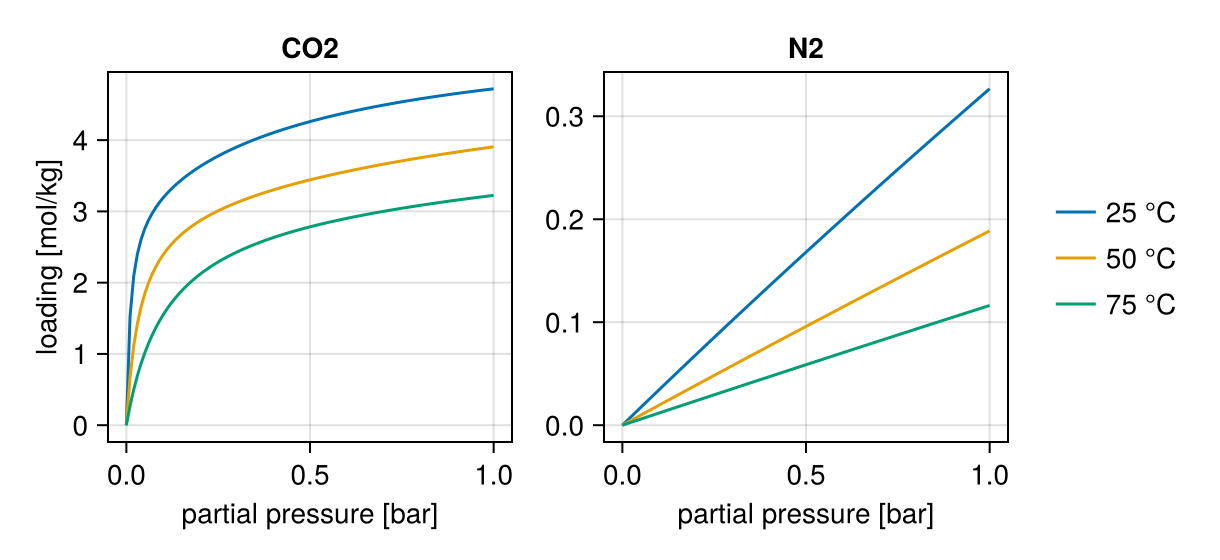
| CO2 | 3489 | 8.65e-7 | -36.64 | 2872 | 2.63e-8 | -35.69 |
| N2 | 6614 | 2.5e-6 | -15.8 | – | – | – |
Density 1130 kg/m³, particle diameter 2.0 mm, particle porosity 0.35, tortuosity 3.0, heat capacity 1070 J/(kg·K).
Zeolite 13X (Krishnamurthy et al. 2014)
The adsorbent of the wet flue gas processes. Its CO₂ and N₂ parameters are close to those above, and it adds water. Water is held very strongly: at 25 °C the zeolite is nearly saturated with it below 0.5 kPa. Library name "zeolite_13x_krishnamurthy_2014". 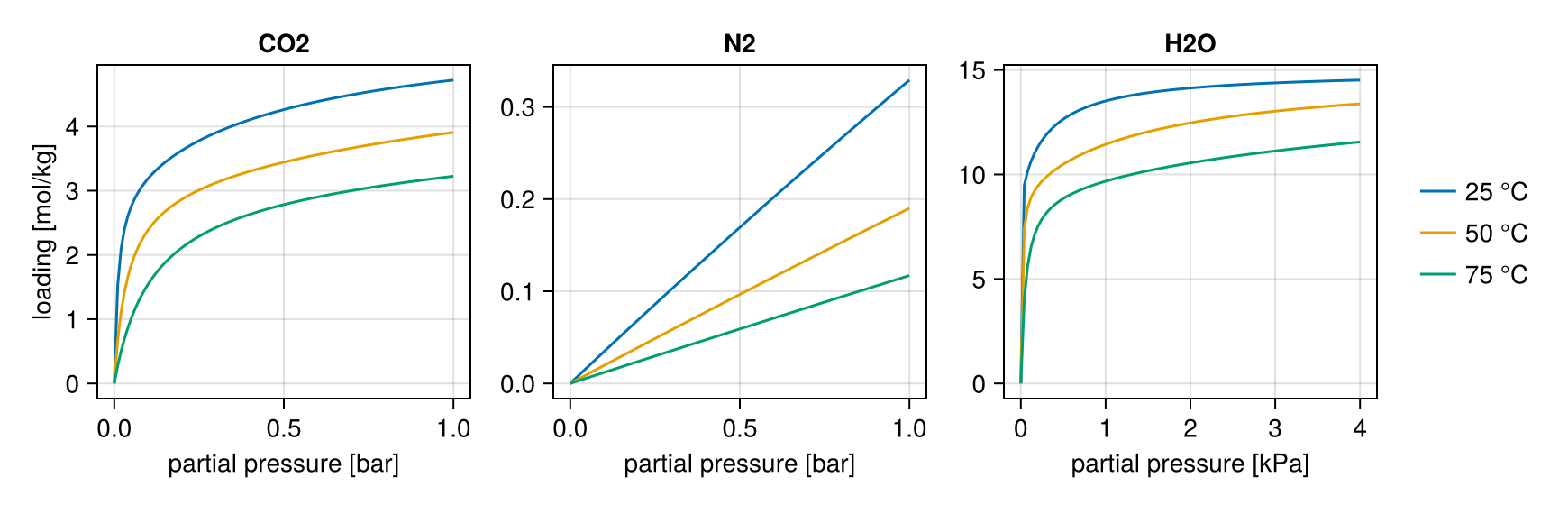
| CO2 | 3489 | 8.65e-7 | -36.64 | 2872 | 2.63e-8 | -35.7 |
| N2 | 6614 | 2.5e-6 | -15.82 | – | – | – |
| H2O | 10470 | 2.35e-7 | -55.72 | 6434 | 7.99e-8 | -45.48 |
Density 1130 kg/m³, particle diameter 2.0 mm, particle porosity 0.35, tortuosity 3.0, heat capacity 1070 J/(kg·K).
Silica gel (Krishnamurthy et al. 2014)
The water-removal bed of the dual-adsorbent process. It holds about a fifth as much CO₂ as zeolite 13X at 1 bar, and takes up water more gradually. Library name "silica_gel_krishnamurthy_2014". 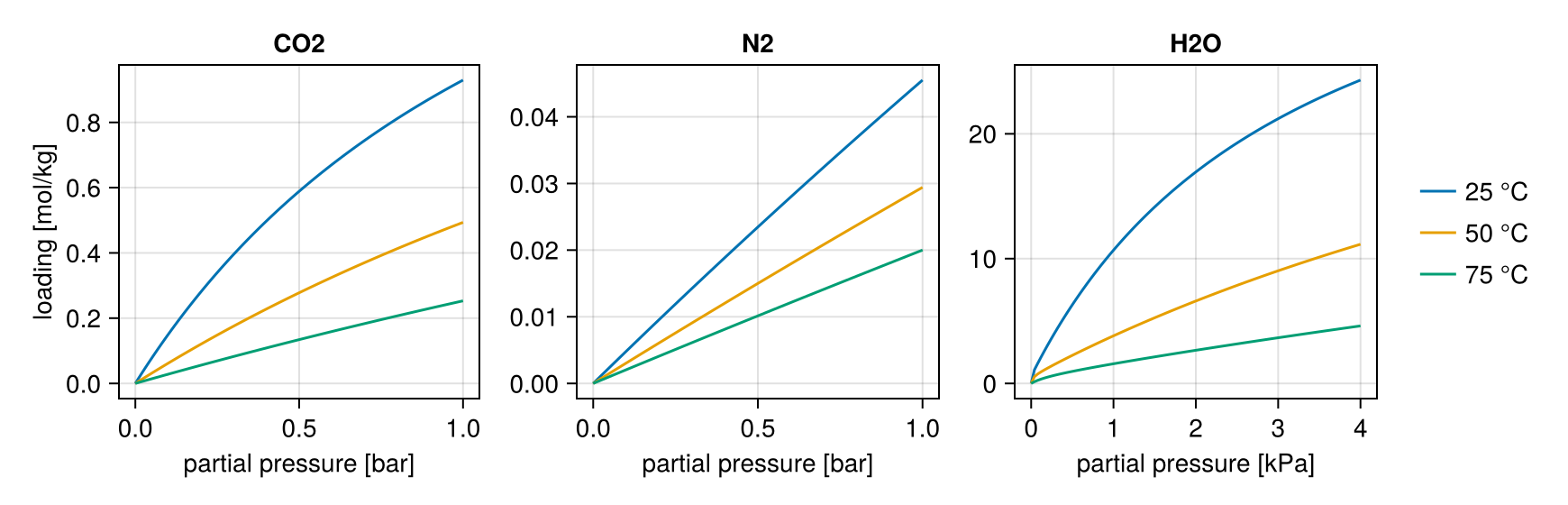
| CO2 | 2692 | 3.2e-7 | -27.12 | – | – | – |
| N2 | 918.9 | 1.2e-5 | -12.12 | – | – | – |
| H2O | 718.1 | 5.6e-13 | -89.2 | 52630 | 7.74e-8 | -39.9 |
Density 1220 kg/m³, particle diameter 2.0 mm, particle porosity 0.35, tortuosity 3.0, heat capacity 1070 J/(kg·K).
Your own adsorbent
Write the isotherm with dual_site_langmuir or langmuir, make an Adsorbent and save it with save_adsorbent to use it again; the Building a process from its parts example does this, and Process files shows the file format. Check it against the source with equilibrium_loading and isotherm_table, which report mol/kg. Other isotherm models can be added with register_isotherm!.